

Last Sunday was Father’s Day and it was hard not for me to think of my own father who passed away June 28th, 2021. Eight days from today will mark the two-year anniversary of dad’s passing. I miss dad a lot. The above picture is one with my dad where I believe I was a recent high school graduate, circa. 1989. The second picture is one of my dad napping with Isaac who was two-months-old at the time. Isaac just finished his first year of university at Gonzaga. Dad was such a GREAT grandfather. Of course, last week was also our son Calvin’s high school graduation. We are so proud of all that Calvin has accomplished, how he fought through the difficulties of the pandemic, online learning, etc.
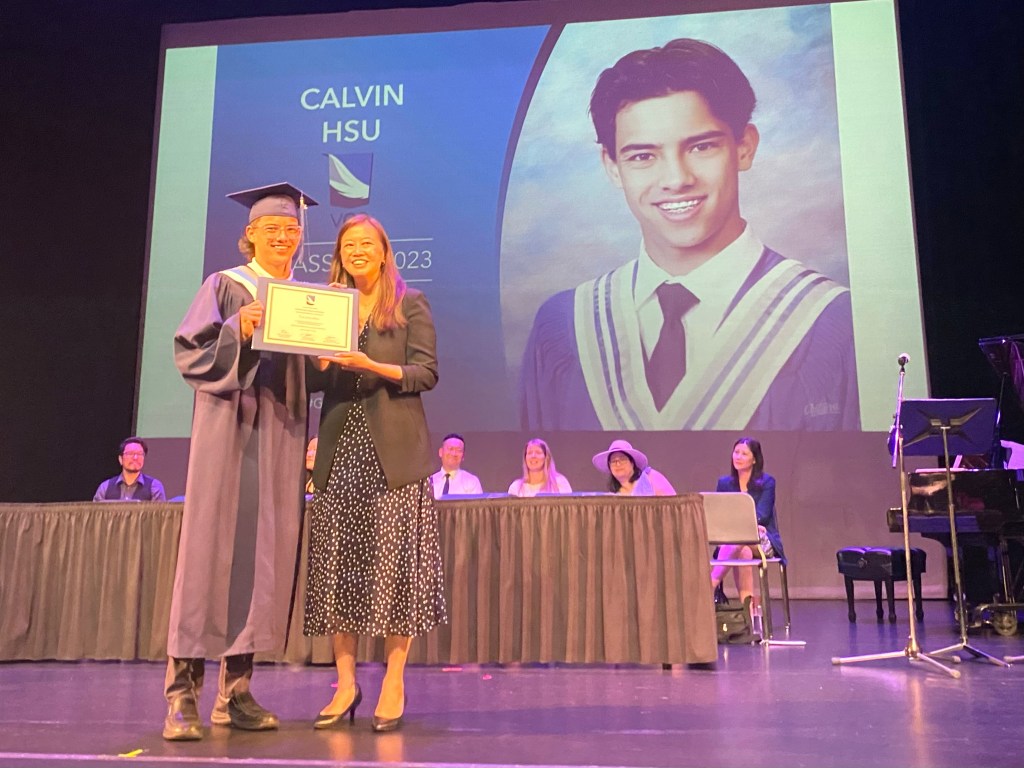

School is not Calvin’s favourite thing, but volleyball is and with the opportunity to play volleyball for the UBC men’s team this fall, Cal knows that working hard in school is vital. Again, we are so proud of Calvin for his hard work and pushing through the last few years to graduate. But it’s not just the school and athletic accomplishments of our son that brings us joy. I used to quote to our kids when they were young Walker Percy’s famous line, “it’s possible to get all A’s and still flunk life.” Calvin might not have gotten all A’s (though his grades have been solid enough), but he is growing as a young man and in so many ways, “passing life.” Calvin has a heart of compassion and has become such a caring individual, for which I am so immensely proud. A couple of evenings ago, it was late at night and I had just returned home through our back alley and walked through our back gate into the house. Not too far off from our back gate in the back alley was a homeless man digging in our trash bin and mumbling to himself. To be honest, I was pretty tired and thought “no harm, no foul” if the guy could find something he needed in our trash bin, but that I was ready for bed. But Tanya and Calvin felt differently than I. Tanya was concerned for trash being strewn all over the back alley and Calvin was interested in knowing more of the man’s story. So the two of them devised a plan to bring out a bag of aluminum cans from our recycle bin to see if that is what the homeless man was looking for. This would address two concerns hopefully; one, get the man to quit tearing open our garbage bags and two, give him potentially what he was looking for. So Calvin was sent out back with the aluminum cans, and I was genuinely tired and thinking of going to bed. But then, to be honest, not so much motivated by a charitable and merciful heart (as Calvin), but a bit out of anxiety for my teenage son, after a couple of minutes, I decided I would head out back to see how things were going, to make sure Cal was OK. There I found Calvin talking with the homeless man. His name was Stu. Stu shared his story as Calvin listened intently. Stu was from the UK and had fallen on hard times. His father was flying in from the UK on Friday to help him out (the day was last Wednesday). Hooray for loving fathers. And you could tell that Stu really enjoyed the conversation and being seen not as an object for scorn, but as a person with dignity. Mid-sentence, he paused and asked the two of us if he could read a poem he had written. Digging into his grocery cart of items, he pulled out a sheet of paper where he had written a poem and read it to us; in many ways the poem was heartfelt and touching, thoughtfully written. We brainstormed a bit about how we might help Stu- he appreciated the aluminum cans, but was looking for bigger items he might be able to sell. He had eaten so did not need food at that moment. While the eastside is a place with more resources, Stu said that he felt that the westside was a safer place to find a place to sleep. Stu said, “on the eastside, you put your head down, wake up, and all your possessions have been stolen” (referring to his grocery cart full of items). Stu paused as we brainstormed, and said we had given him the greatest gift in just seeing him as a person and listening to a bit of his story. I was so proud of Calvin for taking the lead here. As we prepared to part ways, Calvin then asked Stu, “can I give you a hug?” Stu said he would enjoy that, took off his gloves with which he had been digging in the trash bins and then Calvin gave him a long and hearty embrace. I followed suit and gave Stu a big hug. And then as we were finishing up, I said to Stu, “you know Stu, we are a praying family, can I have your permission to pray for you?” Stu responded, “I’m an atheist, but I could really use the blessing right now, so yes, please do.” Stu, Calvin and I formed a three-way huddle with arms around one another, and I prayed for Stu and as I ended “in Jesus’ name, Amen,” Stu did the sign of the cross across his head and chest, which I thought was beautiful in a way. As Stu was leaving, he asked for our contact information, to which I gave him mine. He said that when he got himself “cleaned up,” he wanted to reach out to us again and share the good news. Again, I was so proud of Calvin teaching me that there are opportunities God puts before us, that if we simply do what is “comfortable,” we miss the blessing. Sometimes the young lead the way.
As I thought about my dad on Father’s Day and as I think of my sons, I couldn’t help but think of Marilynne Robinson’s book Gilead which is about the love of an elderly father for his seven-year-old son, the father John Ames, knowing that he will soon die of a heart condition. Therefore Ames grieves that he will not be able to see his son grow up and wants for his son to know him through his memoir. Ames writes to his young son of his great love for him, in poetic language says, “I can tell you this, that if I’d married some rosy dame and she had given me ten children and they had each given me ten grandchildren, I’d leave them all, on Christmas Eve, on the coldest night of the world, and walk a thousand miles just for the sight of your face.” My dad was never one for words, but I always knew how great his love was for me. I am a bit more of a writer than my dad. While not the poet John Ames through Marilynne Robinson’s was, nonetheless, I wrote a tribute to my dad in the acknowledgments section of my dissertation that I completed in 2017. This was early on in dad’s dementia battle when we were still determining the exact kind of dementia he had, which would turn out to be Lewy Body Dementia. The tribute also recognized a journey dad had to undergo in coming to terms with the fact that I wasn’t going to become a medical doctor as he had been and as his father, my grandfather, had been. Initially, dad was opposed to me leaving the pre-med track of my university degree and planning to pursue a theological education. In time, he came to embrace my decision and even said he was glad for it. And the last conversation I would have with my dad would end with a prayer and with dad’s final words, in the midst of speaking mostly gibberish, being with great clarity to finish the prayer, “thank you and Amen.” I’m grateful. Dad died on a Monday eight days after Father’s Day 2021. Despite the pandemic making it difficult to travel back and forth between here and Seattle, nonetheless, Tanya and I had been blessed to FaceTime him that Father’s Day 2021. Here was a picture we caught from the call Tanya and I had together with him.
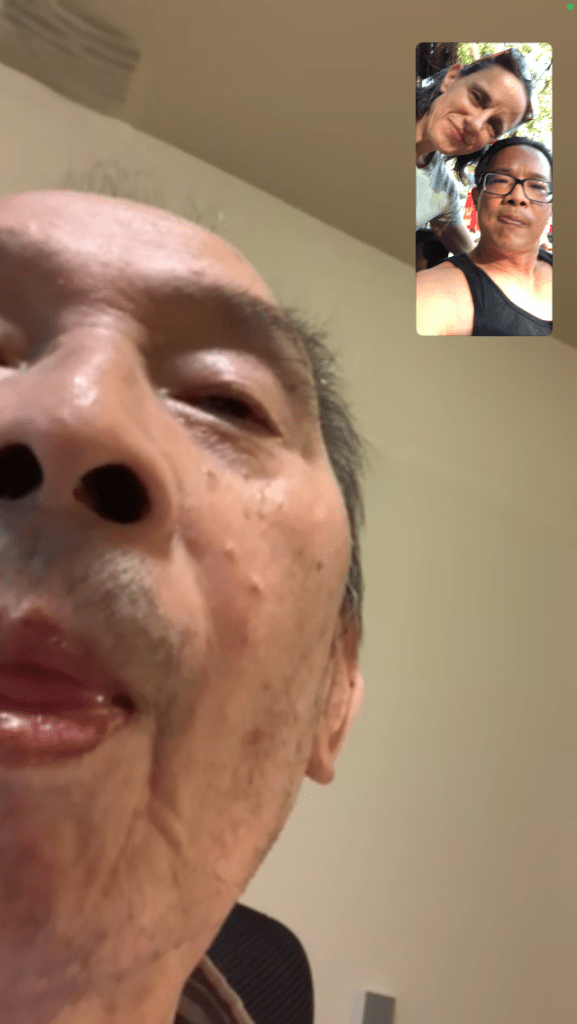
So here was my tribute to dad in my dissertation:
Dad, even as you battle uphill against the ravages of lewy bodies and Alzheimer’s, I have always cherished your interest in me and how proud you are of me. Thank you for so often calling me just because you wanted to connect. Even today you called me in the middle of a confusing day. Even though this is not exactly what you had in mind years ago, I am happy to be called Dr. Hsu, the son of Dr. Hsu.
I try to be grateful when I think of my dad. Everyone’s story is a bit different. Dad lost his dad, my paternal grandfather, when he was barely thirty-years-old. My father-in-law Ed lost his dad when he was nineteen, in a tragic accident where his dad was doing construction and fell to his death. In Robinson’s story, John Ames is writing of being an elderly father with a young child but with a terminal heart condition that will soon lead to his death. When I struggle some days to understand why such a great father and grandfather was taken from us, in my opinion, far too early,… when we started to say the “long goodbye” in 2015 and then then final one in 2021, instead of growing angry or bitter, I do my best to remember all that dad was to us,… to be grateful. I’m grateful, and I try to be grateful in the darker moments. Dad taught me so much, and so I’m grateful.
Well, last week was also an enjoyable one, in addition to Calvin’s graduation, I was able to get my first open-water swim of the season. I did so with my longtime friend Kai who has swam with me since 2016. I remember back in 2013 how much grieving we as a family were undergoing having left our former town, church, neighbourhood and friends. We loved everything about the place we had been for fifteen years, but out of a sense of call to Vancouver and Grace Vancouver, discerned that we were to load up the moving truck and move the family to Canada. I have to admit, it has always been difficult for me when people leave a church because they see the programs of that church as being insufficient for their children. The reason for my frustration is because we had the experience of uprooting our kids from their places of flourishing in the US in the town where they were born and had made lifelong friendships and had spiritual grandparents and then moving them 2000 miles away,… for the cause of the Gospel. We did all this in order to help serve Grace Van because the need for the Gospel was so great in a place like Vancouver. It’s odd bringing a family 2000 miles to serve and then have some say the sacrifice is too great for their families to stay with their children, to build a small church. It’s one of those things I’ve had to work through as a pastor of a small church these last ten years. In some ways I get it as I left a mid-size church in 2013, one that began even smaller than Grace Van, that a bigger church can provide more “services” to the community. Nonetheless, I have grown in my conviction through the years that going to a church for the kids, as a parent, is a lot like the tail wagging the dog. Maybe this is obvious, the dog should be wagging the tail! I remember a few years back when we made plans to hire a discipleship pastor, a handful of families left saying to me, “Mike, we adults don’t need to be discipled, but our kids do and so we are going to find a church with a solid youth program for our kids.” We do need to disciple our youth and young ones no doubt, and raising them in this secular city is very hard. I get it- having raised three kids here, I know the culture catechizes them and that it is not easy to raise them to believe in the power of the Gospel when the world is so present here. I get it, but what if these families that had left had said instead, Grace Van is a small church with limited resources, and the need for youth and children’s discipleship is so great, so why don’t we be a part of seeking to provide support for our young people? I remember another young mother saying to me, “Pastor Mike, I watch my kids throughout the week and am exhausted, so when I come to church on Sunday, I want a break from my kids and do not think I should be asked to volunteer downstairs.” Yet, all these ways of thinking about our young people misses the heart of the Bible’s theology that sees God’s people from young to old alike, being “covenanted” together with both privileges as well as responsibilities to assist one another in their nurture. I’ve found only joy and privilege whenever I have been able to spend time with our young people at the church. We make promises at the baptisms of our young ones as well as when we take covenant membership vows together, and so this is why I want to give a shout out to all who work so tirelessly and diligently to see our children and youth taught and nurtured. A shout out here especially to Tracy Quan and Misha Sisco!!! Oh, but this was a reflection on my love for open-water swimming and how it helped me to adjust to life in Canada. So I digress, haha.
Well, we were struggling to adjust to life in Vancouver and back in 2015, near the end of my second year here, while the family was still adjusting to life in Canada, I began doing open-water swims and doing classes to teach me how to “sight.” Open water swimming is so different from the pool in that you have no idea if you are going in a straight line with the currents and lack of visibility. So you learn to “sight” by every couple of strokes, putting your eyes out of the water (but not mouth) like an alligator, to see if you are still on line for where you are trying to go. Kai and I met in a swim class back in 2016 and have tried to swim together each summer since then (minus the years of the pandemic). I’ve always loved the water, probably because I grew up near a lake. But also the water reminds me a lot of my mother who loved the ocean. One of the ways I began to feel like Vancouver was becoming home was not only to enjoy the waters being nearby, but to become immersed in them, literally. I felt like a Vancouverite whenever I would swim in its waters nearby. While the saying goes, you are not truly a Vancouverite until you’ve done the Grouse Grind, my experience is that I began feeling like a Vancouverite as I would swim in its nearby waters. My dissertation topic was on how people like me, a ministry leader, in time develops a sense of belonging here. Swimming in Vancouver waters has been very orientating for me. I’m also grateful for many of my relationships outside the church as well, those I have with friends like Kai, as they give me the opportunity to connect more broadly to others as well as seek to be positive influence and light for them as well.

Well, in addition to finding a sense of community and belonging in the city of Vancouver, of course the church has been vital for me as well. In particular in our transient city, “city of exiles” as my dissertation uncovered, in many ways it’s those folks who have stayed planted, despite influences and pressures to do otherwise in a city like ours, where we have received the greatest blessings. We are so grateful for the last ten years at Grace Van in large part because we are so grateful for those who have remained rooted and stayed with the church through thick and thin. Simone is a young lady who just under two weeks ago received her teaching degree. We are so proud of Simone as we were able to attend her graduation ceremony. But we are also grateful for our dear sister who came to the church at the age of twenty and has remained with us for the last eight years, serving here for almost as long as we have been here! It’s folks like Simone who have kept us going through the hardships of life and ministry in a challenging place like Vancouver. We are grateful for the community we have enjoyed especially inside Jesus’ Church where Christ has been at the centre. God has been so very kind to us. It was Cyprian who once said that there is no ordinary salvation outside the church. That quotation has been often misused to promote some kind of dead institutional religion where folks are expected to conform to the deadness of that institution and its leaders, as Jaroslav Pelikan once quipped, “the dead faith of the living.” I think rather that in our day and age where we are primary individuals and consumers going to church for “what I (and perhaps my family) get out of it,” rather than for service and sacrifice for the cause of the Gospel, that perhaps the quote is needed today more than we know, “that there is no ordinary salvation outside of the church.” It’s Jesus’ Church where people come not only to know Christ, but also see the power, authority and blessings of the Kingdom of God demonstrated. Really, it’s in how we relate to one another and do life together that gives the Gospel credibility. To quote from Lesslie Newbigin, “the congregation is the hermeneutic, i.e. interpreter, of the Gospel.” On this sabbatical, I am working towards my own wholeness and healing, but I hope to return more jazzed about Jesus’ Church than ever. Perhaps once we as Jesus’ Church become powerful in love and service to one another in our communities, the Gospel will grow powerful as well in our city. We are proud of you Simone in so many ways! Remember the Walker Percy quote my kids heard all-to-often? “It’s possible to get all A’s and flunk life.” I’m sure you got your fair share of A’s, but the most important thing is that you are passing life with flying colours! As with Calvin, as a father, so it is as a pastor, that my fatherly heart finds great joy in the success of God’s children. As the Apostle John would often refer to congregants as “dear children,” so I find great joy as well when God’s children are flourishing and doing well in the Lord.

Well, I have more to say, especially about some of what I am learning in my weekly book group through Christopher Watkin’s Biblical Critical Theory, but I suppose that will have to wait for another post : )

 The Eudaimonia Blog
Leave a comment